
Ⅰ. Introduction
Gypsum is a widely‑used raw material in the building‑materials industry, employed to manufacture various construction products such as gypsum boards, gypsum blocks and plastering materials. The contents of major elements (calcium, sulfur, silicon, aluminum, iron, etc.) and trace impurity elements in gypsum directly determine the physical properties, setting characteristics and final quality of finished products. In building‑material production, rapid and accurate acquisition of chemical compositions for gypsum raw materials and finished products serves as a critical link to guarantee stable product quality and optimize process control.
Conventional analytical methods for gypsum components mainly rely on wet‑chemical analysis, which features cumbersome operating procedures and long testing cycles, and can hardly meet the rapid‑detection requirements of modern production lines. X‑ray Fluorescence (XRF) technology has been extensively adopted and validated for gypsum composition analysis owing to its advantages including simple sample preparation, fast analysis speed and simultaneous multi‑element determination. The ScopeX CS Vacuum X‑ray Fluorescence Spectrometer (click to learn more) delivers an efficient and accurate solution for gypsum composition testing in the building‑materials industry.
Ⅱ. Importance of Gypsum Composition Testing
The performance of gypsum and its products is closely related to their chemical compositions. Accurate determination of elemental contents in gypsum is of great significance for multiple production links:
1. Raw Material Quality Control: Impurity contents (e.g. SiO2, Al2O3, Fe2O3) in natural gypsum or desulfurized gypsum raw materials will affect the purity and whiteness of products, which requires rapid screening upon incoming‑material arrival.
2. Production Process Control: The contents of sulfur, calcium, silicon, aluminum, iron, magnesium, potassium and other elements in gypsum exert direct impacts on setting time and strength development. On‑line testing facilitates timely adjustment of batching formulas.
3. Product Quality Evaluation: In accordance with standards such as GB/T 9776, various components of gypsum products shall comply with limit requirements, and accurate testing serves as the basis for quality evaluation.
4. Resource Utilization Assessment: Industrial by‑product gypsums such as phosphogypsum and desulfurized gypsum feature complex compositions, and their resource‑utilization value depends on composition‑analysis results.
Ⅲ. Application Case
Testing Instrument: ScopeX CS Vacuum X‑ray Fluorescence Spectrometer
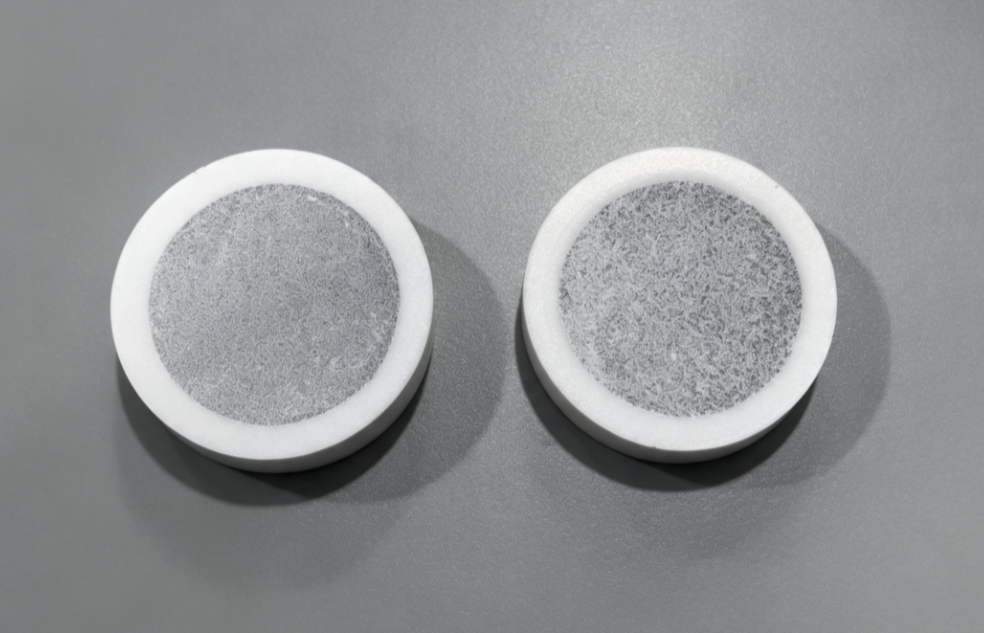
Sample Preparation: Gypsum samples are ground to below 200‑mesh, and then prepared by the pressed‑powder pellet method. The samples are compressed under high pressure to obtain pellets with flat, dense and uniform surfaces. See the figure below:
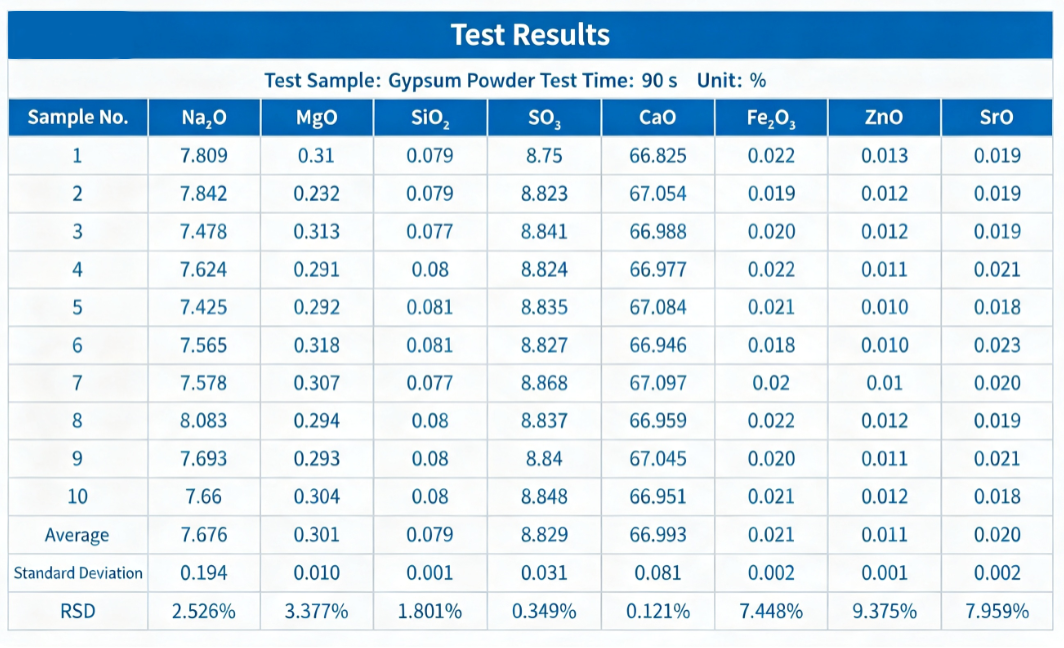
Test Results:
Ⅳ. Conclusion
Benefiting from its superior light‑element analysis capability, wide element detection range, rapid testing efficiency and user‑friendly operation workflow, the ScopeX Vacuum X‑ray Fluorescence Spectrometer delivers reliable technical support for gypsum composition testing in the building‑materials industry. Covering incoming‑material inspection, production quality control and product sampling assessment, ScopeX CS can satisfy gypsum compositional‑analysis requirements across diverse scenarios. Equipped with vacuum system, automatic switching of multiple collimators and intelligent software, it enables accurate quantitative analysis of elements including S, Ca, Si, Al, Fe, Mg and K in gypsum. It is an ideal instrument for building‑material manufacturers, quality‑inspection institutions and scientific‑research institutes to conduct gypsum composition testing.