Research Background
The Core Mission of Thermoelectric Materials: To achieve direct and reversible conversion between thermal energy and electrical energy.
Their application scenarios include:
Power Generation: Utilizing industrial waste heat, automotive exhaust waste heat, and even the temperature difference of the human body for power generation (thermoelectric power generation).
Cooling/Refrigeration: Used for cooling precision instruments and local temperature control (solid-state cooling/refrigeration), offering advantages such as no vibration, low noise, and compact size.
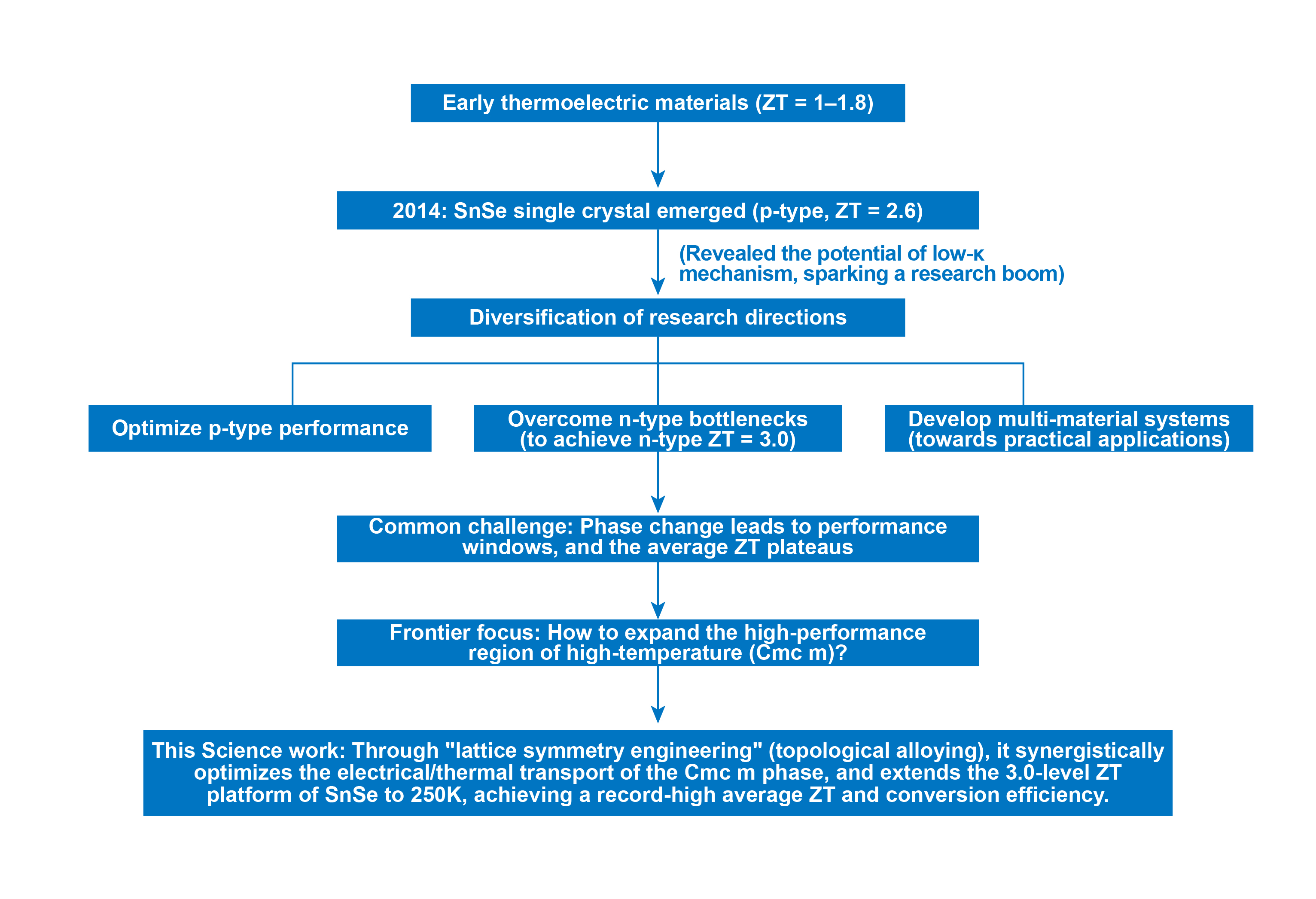
Recently, a research team led by Professor Zhao Lidong from Beihang University, in collaboration with Taiyuan University of Science and Technology, has made significant progress in the field of thermoelectric materials. This study broadens the stable temperature range of the high-temperature Cmcm phase in tin selenide (SnSe) crystals, enabling control over the lattice symmetry of the N-type SnSe crystal Cmcm phase and significantly optimizing its "two-dimensional phonon/three-dimensional charge" transport properties. It successfully extends the outstanding thermoelectric performance of N-type SnSe crystals (with ZT~3) from a single temperature point to a wide temperature range of 250°C (with ZTave~3), achieving a single-leg power generation efficiency of approximately 19.1%. These findings demonstrate the immense potential of N-type SnSe crystals in thermoelectric power generation, laying a solid foundation for the development of all-SnSe-based thermoelectric generators.
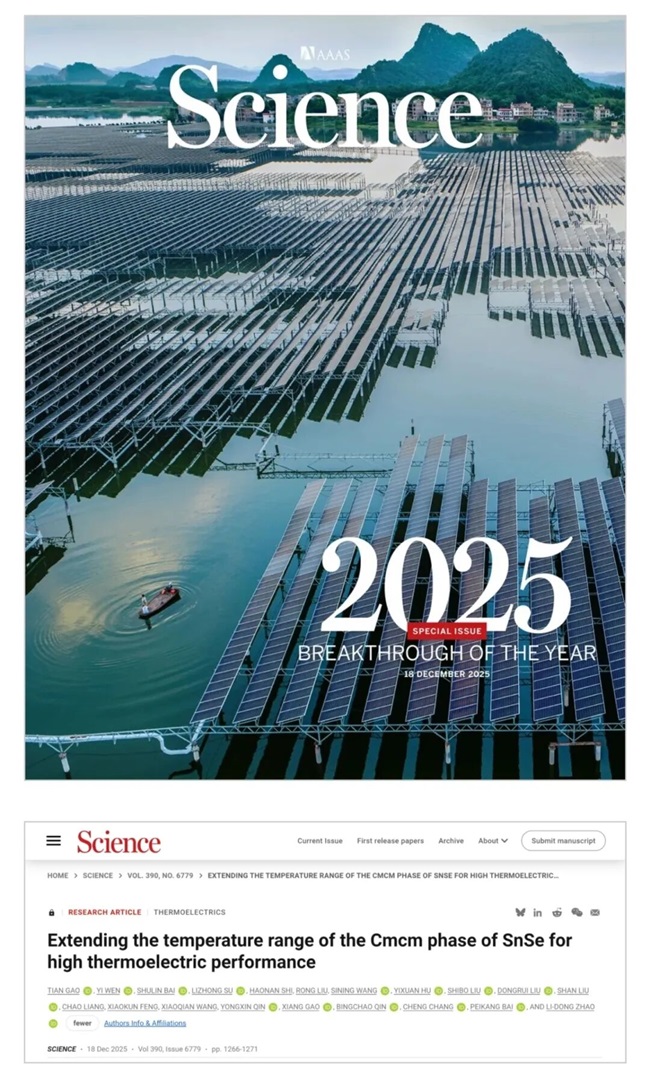
Title:《Extending the temperature range of the Cmcm phase of SnSe for high thermoelectric performance》
Journal:《Science》
Article Link: www.science.org/doi/10.1126/science.adt0831
Innovative Strategies:
Thermoelectric power generation requires a high dimensionless figure of merit (ZT) over a broad temperature range. Two-dimensional phonon and three-dimensional charge transport enable n-type Pnma tin selenide (SnSe) crystals to achieve a ZT peak of approximately 3.0 at 748 Kelvin. This study focuses on the high-symmetry Cmcm phase to enhance two-dimensional phonon and three-dimensional charge transport and extend the high-performance (ZT ~3.0) plateau. By simultaneously broadening the stable temperature window of the Cmcm phase and enhancing lattice symmetry through lead alloying, we have expanded the high-performance plateau from a single temperature point to a wide temperature range of approximately 250 Kelvin. This n-type characteristic is exhibited in chlorine-doped, rock-salt-like Cmcm SnSe crystals. An average ZT of approximately 3.0 was achieved between 673 and 923 Kelvin, with a conversion efficiency of about 19.1% under a temperature difference of approximately 572 Kelvin.
Lattice Symmetry Engineering: By applying high-concentration lead alloying (23%), we not only reduced the phase transition temperature but, more importantly, altered the local lattice symmetry of the Cmcm phase, bringing it closer to the higher-symmetry "rock-salt-like structure."
Synergistic Optimization Mechanism: This innovative approach lowers the deformation potential and weakens the scattering of charge carriers by phonons, thereby maintaining or even improving carrier mobility at high temperatures despite a significant increase in carrier concentration (addressing the challenge of strong high-temperature scattering). Concurrently, the band structure was modulated to enhance the density of states effective mass, compensating for the reduction in Seebeck coefficient caused by the increased carrier concentration. From a thermal perspective: Pb alloying induces bond softening, further reducing lattice thermal conductivity.
Groundbreaking Achievement: Ultimately, in the Sn0.77Pb0.23Se0.95Cl0.05 material, the high-performance plateau with an average ZT of ~3.0 was extended from 673 K to 923 K, spanning a range of 250 K, while achieving an exceptional conversion efficiency of 19.1%.
Material Property Characterization
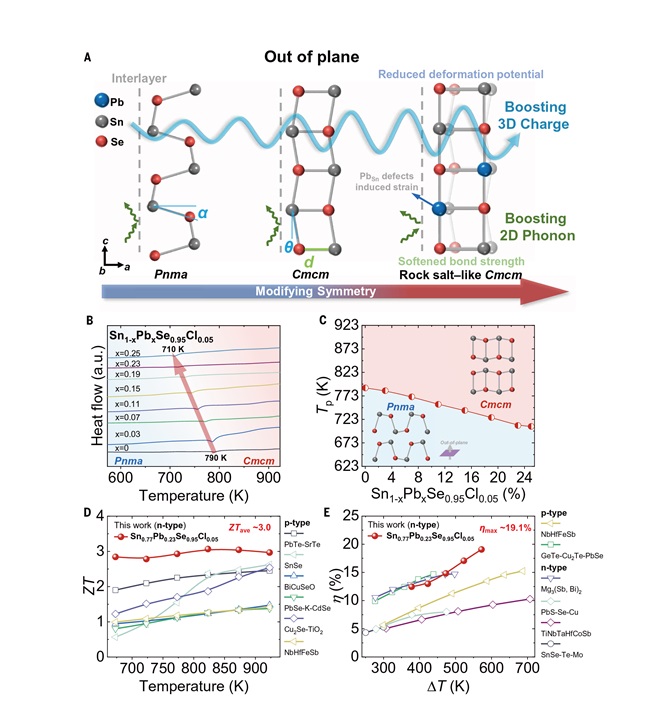
Fig. 1.Wide–temperature range high thermoelectric performance in Cmcm SnSe crystals by boosting 2D phonon and 3D charge transports.
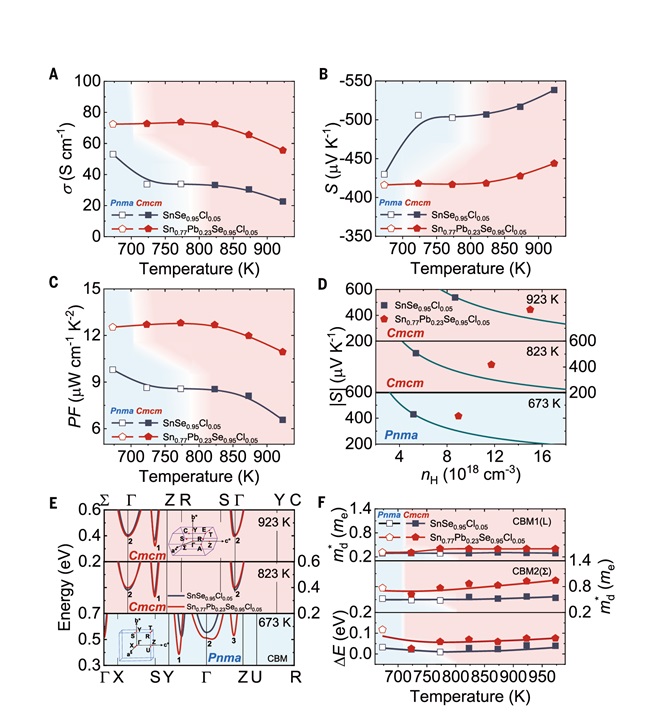
Fig. 2. Electrical transport properties and band structures of SnSe0.95Cl0.05 and Sn0.77Pb0.23Se0.95Cl0.05 along the out-of-plane direction at 673 to 923 K.
Material XRD Characterization
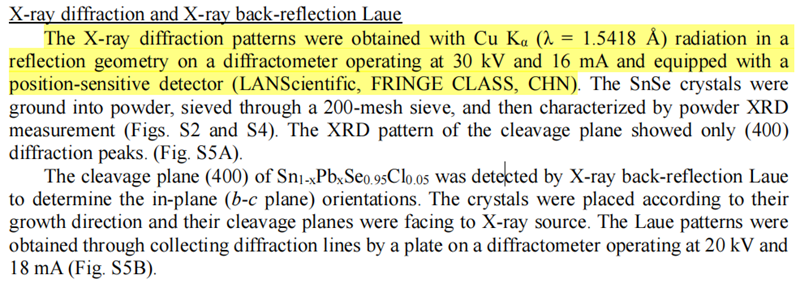
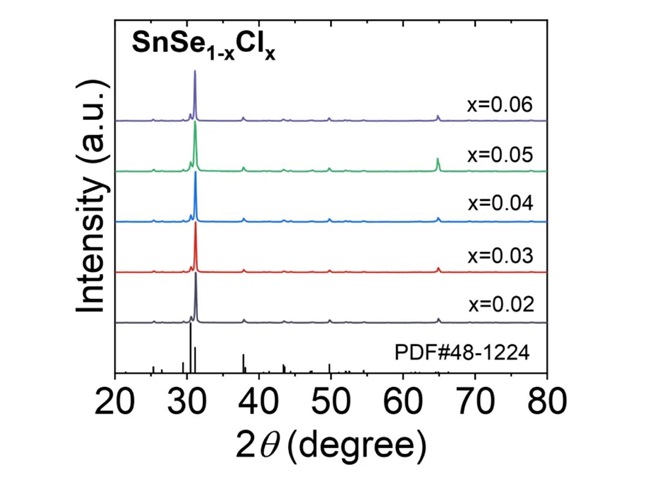
Fig. Powder X-ray diffraction patterns of SnSe1-xClx.
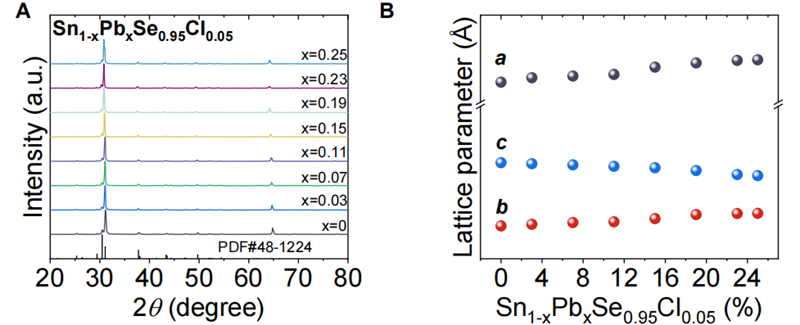
Fig. X-ray diffraction results of powder samples. (A) Powder X-ray diffraction patterns of Sn1- xPbxSe0.95Cl0.05. (B) The calculated lattice parameters of Sn1-xPbxSe0.95Cl0.05.
Empowering Scientific Research and Innovation
The involvement of the FRINGE series X-ray diffractometer in this Science-level research achievement not only validates the technical strength of LANScientific in the field of high-end analytical instruments but also signifies that China's independently developed scientific instruments have reached a relatively high international standard. Throughout the entire process—from crystal structure analysis to quantitative phase analysis—LANScientific's XRD instrument, with its outstanding stability and precision, has served as a reliable assistant for scientists in exploring the unknown and producing world-class results.
Moving forward, LANScientific will continue to drive technological innovation, contributing Chinese wisdom to human scientific exploration with robust technological capabilities. We are committed to enabling more scientific instruments "Made with Chinese Expertise" to shine on the global stage of scientific research.

